The abuse of alcohol is dangerous for your health. Drink responsibly. Veuve Clicquot supports the responsible consumption of wines and spirits, through Moët Hennessy, member of Spirits EUROPE, Discus and Wine in Moderation.

Champagne is a sparkling wine under pressure. Bottles should be handled with care.
Do not saber the bottles.
Here are the recommended steps:
Step 1: Ensure the bottle is at the ideal serving temperature.
Step 2: If the bottle is damp, wipe it with a cloth.
Step 3: On a stable surface, remove the part of the foil that covers the wire cage and the cork.
Step 4: Loosen the wire cage while holding the cap with your thumb.
Step 5: Tilt the bottle at a 45° angle, avoiding pointing it towards yourself or a guest. Step 6: While firmly holding the cork with one hand with your thumb on the cap, rotate the base of the bottle to gently extract the cork without letting it escape.
Craving the perfect chill?
Chill RICH Cuvée to 4 degrees Celsius.
Pop the cork and fill its dedicated glass halfway.
Add an ice sphere, sip, and savor.
Picking a glass isn't just about looks; its shape, size, and thickness reveal different sides of your champagne’s personality!
Preferred options are the white wine glass and tulip glass.
Hold the glass by the stem to keep the bubbles cool.
Wondering about the champagne bottle-to-glass ratio?
A bottle serves 6 to 8 glasses, depending on the pour.
Whether you prefer a heavy, light, or perfect pour, there is always enough to go around.
There’s something magical about sipping champagne at the perfect temperature—8 to 10 degrees Celsius.
Immerse the bottle in a half-filled ice bucket for 30 minutes or place it in the fridge for a few hours.
Only the perfect chill can do justice to such elegance.
Calling all champagne lovers!
For unopened bottles: non-vintage lasts 3 to 4 years, magnum or jeroboam adds 2 to 3 years, and vintage lasts 15 to 20 years or more. Keep bottles within the following temperature range: 45-65°F.
For opened bottles: with a proper stopper, it stays lively for about 2 days.
For further details, please see the bottom section of the page.
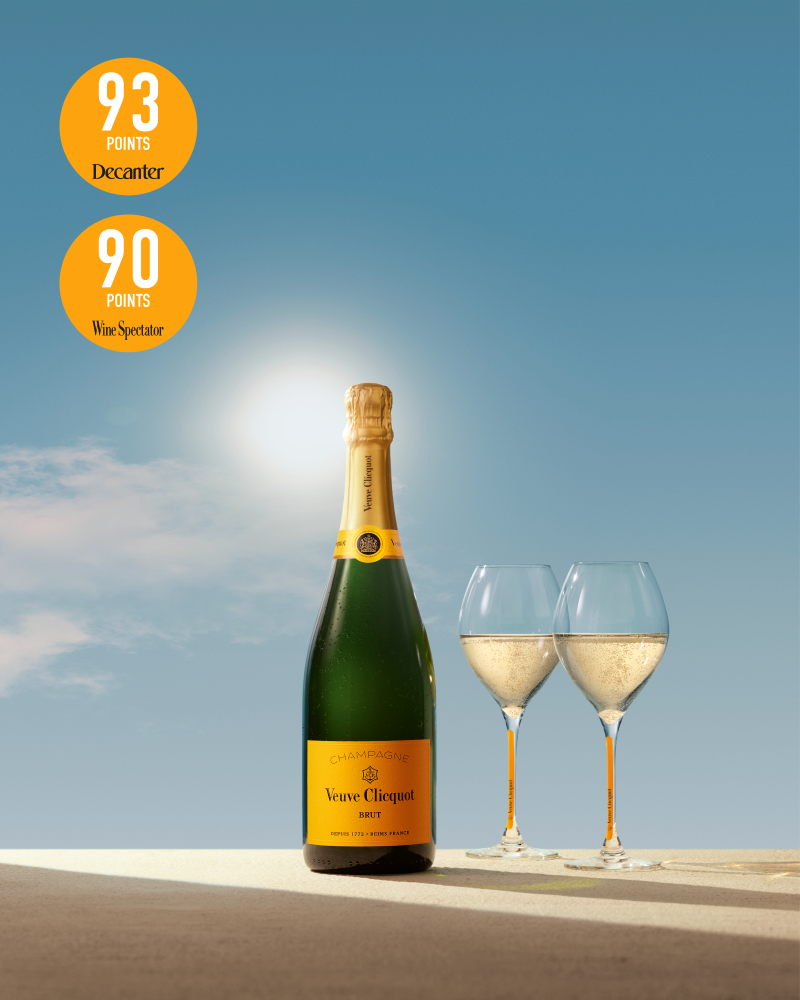
Yellow Label truly is the House’s signature champagne – balancing all 4 dimensions defining the Veuve Clicquot style: freshness, strength, aromatic richness and silkiness.
At its heart, the legendary Pinot Noir grape that sets Veuve Clicquot apart so distinctly.
Ensure that these bottles have spent at least the last 24 hours before opening in an upright position.
Large bottles will be easier to handle when placed directly on a flat, stable surface.
While firmly holding the cork with one hand with your thumb on the cap, grasp the neck of the bottle with the other hand to perform a slow and controlled rotation of the bottle until you feel the cork detach from the inner side of the bottle neck.
While firmly holding the cork, control its exit in line with the bottle to prevent any sudden expulsion or breakage of the upper part of the cork.
Avoid thermal shock (rapid temperature changes and large temperature discrepancies):
Keep the temperature cool and constant. High temperatures speed up the ageing process and damage the quality of the Champagne. Cold temperatures, although not detrimental, slows down the development of the Champagne.
Do not expose champagne bottles to light or heat:
Light is detrimental to the quality of Champagnes. Champagne is particularly sensitive to light. Transparent glass bottles must be especially well protected.
Maintaining a humidity level above 70% helps to preserve the cork's physical and elastic qualities. Very low humidity and high temperatures can dry out the cork and cause rapid wine transformation.
Avoid shocks:
Handle with care to prevent the bottle from becoming brittle. There are 6 to 8 bars of pressure inside the bottle, which is three times higher than the pressure in a car tire.
There is no general rule. Champagne is unique and has its own ageing potential. It also depends on your personal taste: either you appreciate the wine on the young and fresh side or on the mature side.
In good storage conditions (as stated above):
Our non-vintage bottles can be stored up to 3 years once on the market. Please also note that half bottles age quicker than bottles, and that magnums age more slowly than bottles, so for long-term keeping they are a better choice.
Ageing Champagne longer is possible with our vintages. In good storage conditions they can be stored up to 10 to 15 years (or even more), depending on the vintage (please refer to tasting notes).
Allergens:
All our Champagnes contain sulphites.